Thursday, July 21, 2005

Tony's finally lost it

Tony Blair

After so many years of compromise, expedient lies and unchecked arrogance, Tony Blair seems to have utterly cracked in the wake of extremist Muslim terrorism landing, inevitably, on his doorstep. He hasn't cracked in the theatrical way that we usually associate with going insane (that might affect his polls). But if we take a moment to feel our way into his mental processes (wearing very thick gloves of course), we can sense the frighteningly hermetic isolation of individual psyche from collective reality that speaks of schizophrenia's catastrophic split.

Public discussion on the crucial issues here is crippled, as ever, by basic logical errors. We conflate the condoning of terrorism with understanding terrorism. As anyone will agree (in any other context), understanding a problem is pretty much a prerequisite to solving it; therefore, in this simple, scared way of thinking, our fear of capitulation to the forces of barbarism instantly scuppers any chance of moving past this dark phase of history.

Keenly aware of his tottering reputation as Iraqi civilian bodies pile up, with the glaring absence of Hussein's WMD's as a damning backdrop, Blair has refused the opportunity for sanity and rationality. As British civilian blood is spilt, on British soil, perhaps people's sympathy with what is occurring in Iraq (and elsewhere) peaks. Now would have been the time to take stock, to come clean, to appeal for hard-nosed analysis and comprehension of the situation we're in.

Instead:

Of course these terrorists will use Iraq as an excuse, they will use Afghanistan. September 11 of course happened before both of those things, and then the excuse was American policy, or Israel. They will always have their reasons for acting, but we have got to be really careful of almost giving into the sort of perverted and twisted logic with which they argue. [...] And you know there is a kind of insidious way of the way that this is looked at where people say yes we entirely abhor the methods of these terrorists, but nonetheless we sort of understand what they are saying about American foreign policy, or Iraq, or Afghanistan or Palestine. No, let us be absolutely clear about this, the legitimate voice of Afghanistan is the man beside me who was elected, not al Queda or the Taliban. The legitimate voice of Iraq is the Prime Minister who was appointed after a democratic election, it is not the Jihadists who are killing innocent people in Iraq. The legitimate voice of the Palestinians is Mahmoud Abbas, the President elected by the Palestinians, it is not terrorists. And therefore I think when people talk about the links between whether it is Iraq, or Afghanistan, or Palestine in what has happened, of course these people will use these things as an excuse, but let's be absolutely clear, if it wasn't that it would be something else, and nothing, but nothing, justifies what they are doing.

- Press conference with Tony Blair and Hamid Karzai, 19 July 2005

So basically, these terrorist guys are just doing it because they're "evil", and they use various conflicts involving Muslims around the world as an excuse to get their nefarious kicks blowing people up. Don't you understand? Even if the entire history of the Christian West's relations to Islam had been one big jovial knees-up, these guys would be killing themselves and dozens of others in the name of the oppression of squirrels, or something.

Note Blair's final point: "nothing justifies what they are doing". Justification and comprehension are conflated, and any attempt at either is booted out the door with a tone of condemnation that no one dare argue with. He even tries to rationally take apart the "we don't condone them, but I can see where they're coming from" perspective. But any pretence at rationality is washed away in a tide of bland, forceful democratic rhetoric. The underlying attitude is: "Now no-one can criticise our foreign policy, because some people who claim to be its opponents are vicious bastards."

In claiming no connection between the London bombings and Iraq, Blair has chronically deepened the hole he's been digging for himself. Pointing out that 9/11 happened before Afghanistan and Iraq is nonsensical, reducing terrorism to some simplistic reaction to single events. Of course the London bombings may well have happened if Blair hadn't waded in with Bush to decimate the cradle of civilisation; but I don't think doing so lightened these guys up. Also, how we should proceed from here in Iraq is a distinct question from, "Why did these bombings happen?"

What is this defensiveness that can't separate these questions out? Blair should at least be up there saying, "OK, folks, we're running about in the Middle East trying to convert this country to democracy by force, plunging this volatile area into bloody chaos. On top of our history there, I think it's safe to say there's going to be some mad bastards trying to lash out at us by blowing some of you to smithereens. I really don't want you to get blown up, but I thought I'd warn you. You all voted me in so I assume you're behind this Iraq thing and are prepared to face the consequences. Sleep tight." But no, reality is too much to bear for Tony now. So, just as any opposition to oppressive, militaristic Zionism is conflated with anti-Semitism, anyone trying to place these "al Qaeda-style" attacks in their historical and global context is obviously trying to justify suicide attacks.

These terrorists, says the New World Order, aren't historical, they have no context; they're just evil, leaking into the world without connections to our real conflicts and international resentments. On such terms are holy wars fought. Bush and Blair's crusade against jihadism is just the other side of the same coin. Christianity and Islam are reduced by our leaders, these hollow earth-denying capitalists with no vision of a viable future, and terrorists to their basest roots in human fear and rage. People will keep dying violent deaths until we truly divine the connections at work here.

You've studied philosophy; you know how much serious time is spent proving the reality of the external world. Imagine having to prove what every animal knows! You know that our main tradition says the world has no qualities whatsoever - no color, no taste, no texture, no temperature - and some of that tradition even denies its existence if we aren't there to perceive it. Ascetic world denial, world destruction going on every day in our philosophy classes. Terrorism and nihilism are already in our Western worldview, so the terrorists are the incarnation of the nihilism inherent to our system of thinking.

- James Hillman

Sunday, July 17, 2005

Farewell America, and the bizarre shock of coming home

So now I've been back in London for over a week, and I've not found time to even catch up on the end of my American trip. I'll keep it roughly chronological, but it's worth mentioning upfront that part of the delay was due to my first experience of full-on jetlag on returning to London being infinitely compounded by the bizarre shock of finding myself in the middle of a terrorist attack on the tube back from Heathrow. I coasted through it in a daze of sleep deprivation and caffeine, and it seems like it's still sinking further in as time goes on. More on that later.

Painted Cave Road

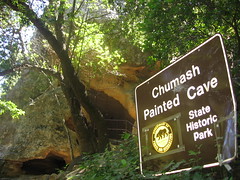
Chumash Painted Cave

The first thing that caught my eye as I scrolled northwest from LA on Google Maps was the Chumash Painted Cave Park just north of Santa Barbara. Michael had told me before I slept on the hill in Topanga Canyon that we were at the border between old Chumash and Tongva territories, and I've been fascinated by archaic/traditional rock paintings for many years now, so it seemed like a good first stop on my journey back towards the Bay Area.
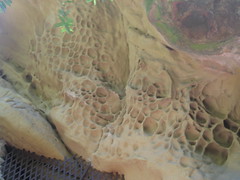
Chumash Painted Cave entrance

I wasn't quite sure of where to turn off the 154 snaking north into the Santa Ynez Mountains, but when I saw that the name of the unassuming turn-off I was approaching was "Painted Cave Road", I thought it was a good bet. Frequently reduced to the width of a car, this road wound up the steep mountainside in ever-tightening twists and turns. The actual cave - just tucked away slightly above a stretch of the road shaded by small trees - was fronted by marvellous natural honeycomb-like formations in the rock. Surely, I thought, a wonder that attracted the people who decorated the cave to this site in particular. It seemed no coincidence to me, either, that just a short clamber down from the road next to the cave was a babbling stream, flushing sparkling fresh water through this parched landscape (many rock art sites in Europe are also oriented in relation to water features in the landscape).

Chumash Painted Cave

The paintings themselves lurked in the upper rear reaches of the shallow cave, the mouth of which was sealed off with iron mesh. It was only on inspecting photos that I could discern the obvious reason for this protection: pointless contemporary initials and other doodles etched into the original paints. The paintings themselves were crowded clusters of crosses, serpentine figures and circles with all manner of decorations suggestive of solar connections. One curious figure stood out as slightly anthropomorphic, with its apparent waving hands, odd triangular shape and strange top hat-like summit. Well worth visiting, as much for the stunning natural frame as the enigmatic art.

Pacific Coast Highway

Heading north past Lake Cachuma and on towards Santa Maria and the Pacific coast, I jammed the personal stereo adapter I'd picked up in Burbank into the car's cigarette lighter socket and tuned the radio in to the weak FM signal it started broadcasting my MP3 player on. A nifty little solution, but not necessarily ideal. I pegged Sonic Youth's blasted guitars as the best soundtrack for the blazing heat and semi-arid hills, but every now and then I'd pass a break in the enclosing landscape and some energetic Latino pop would take over for a minute. A surreal occasional taster of the airborne culture around me.

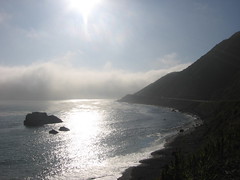
the Pacific coast

Morro Bay heralded the start of the breath-taking coastal drive, and by then I'd decided that I would press on to reach Big Sur before the end of the day. So, armed with a huge bag of nachos, some passable salsa, and Spearhead's bouncing funk, I followed the setting sun northwest.

Big Sur

My main association with this place before arriving has always been the Esalen Institute, a centre for the "human potential movement" whose list of occasional teachers reads like a roll-call for popularisers of modern spirituality who are canny enough to avoid the tacky marshes of the New Age (think Terence McKenna, John Lilly, Colin Wilson, Alan Watts, Robert Anton Wilson and Stanislav Grof, for starters). Heck, Hunter S. Thompson was once the caretaker-cum-security there.
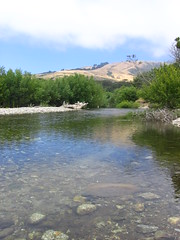
Andrew Molera state park, Big Sur

Well, I noticed the "by reservation only" sign for the centre's 120 acre grounds in passing; Big Sur's associations with people I'm influenced by were quickly swamped by the mind-stopping beauty of the place. Low, almost perpetually cloud-capped mountains rise to the east, the Pacific waves crash on the craggy shores, and in between Route 1 wends its way through stunning redwood forests. I felt like having a soundtrack, but nearly everything seemed out of place against such a swell of natural grandeur. Early Spiritualized instrumentals eventually fell into place as the perfect accompaniment. (It's no coincidence that Sonic Youth, Spearhead and Spiritualized are in alphabetical order. As just skipping tracks is a damn sight safer than browsing through my music folders while driving, the fact that the perfect soundtracks for the series of landscapes through which I drove that day were by bands following each other alphabetically was a grand blessing of serendipity.)

I spent a night at the Fernwood motel, reading Michael Ortiz Hill's book Gathering in the Names, occasionally unable to hold back a tear or two as I drank ale at the Redwood Grill. Co-written with Augustine Kandemwa, Michael's "spiritual twin brother" in Zimbabwe, who initiated Michael as an nganga (healer), it charts the intertwined course of these men's lives up to and past their meeting and mutual initiatory experiences. Michael's experiences as a nurse in the UCLA Medical Centre, tending to the terminally ill, trying to comfort those with hideous facial cancers, dealing with the often cruel practices his job required of him, became the core of his attempts to ground his Buddhist commitment to compassion, via the African tradition of water spirits he had recently taken on. It's sobering reading.

The nearby Henry Miller Memorial Library is well worth a visit, for books, sculptures, coffee and donation-based net access. (Miller said that Big Sur was the first place he learned to say, "Amen!" That's quite a claim given the life he'd lived until he moved there, but then, Big Sur really is that stunning.) Of the local state parks, the Pfeiffer had the most humbling redwoods, though the Andrew Molera - with its meadows and big beach - ended up seducing me for the longest time.

After my second night, in a cabin by the redwood-lined Big Sur river, I was refreshed and ready for my last burst of the Bay Area before flying home via New York.

One last night with New York

Gin and I

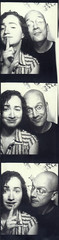
I was glad I left a night and a day spare between my flight into New York from the west coast and my flight back to London - it gave me a chance to catch up on the whole trip with Gin, a new friend I'd only managed to briefly hook up with on my first pass through the city. It was hot, but not roasting in the extreme as during my previous heatwave-plagued stay, so it was nice to experience the place without nearly keeling over. We ended up bar-hopping in Williamsburg, catching a fantastic thunderstorm just after midnight, getting utterly soaked in gorgeous cooling rain. The next bar had a black-and-white photo booth, so we captured our merry, sodden selves for posterity.

Gin got really excited at the prospect that we might not have missed the free pizza at a bar near her place, but it was past 3am by then and it didn't seem likely. Happily they were serving until 3.30. Half three in the morning, buy a pint and you get a good, free pizza. I'd not had pizza in New York so far; seemed like a good way to start, at the end.

I woke the next morning to Gin ragging me about London having won the Olympic bid. The proposed construction's threat to the Lea Valley had left me lukewarm at very best regarding the 2012 Olympics in London, so I couldn't even muster some playful boasts of nationalistic victory. We just headed over to Union Square to enjoy some cake from the farmer's market and some stupendously good iced green tea smoothies.

Welcome home

My flight was from JFK at around 6pm, to land at Heathrow on the morning of the 7th July at around 7am (which would be around 2am by my barely-catching-up-with-New-York body clock). I decided to coast through the next day on caffeine and not crash until the next evening as a way of dealing with jetlag, so I drank some beer in-flight, watched National Treasure (my review: piece of shit!), and generally kept awake.

I was on the Piccadilly Line heading into London by around 8.30am, but the train kept stopping every now and then due to some sort of signal failure at Caledonian Road. By the time more delays were piling up - due to "power surges" - as we approached Zone 1, I was wishing I was back in New York with their air-conditioned subways (which I don't know for sure are more reliable, but the "grass is greener" effect was kicking in as everyone on the tube started cursing London transport under their breath).

My aim for Finsbury Park as my place to switch to the Victoria Line was scuppered by Leicester Square, where the Piccadilly Line service was completely cancelled. I lugged my bags over to the Northern Line, and managed to get up to Warren Street to switch to the Victoria. Any hope of getting straight home was lost by Euston, however, where the tube just sat there.

It's odd in retrospect; at the time, I was just increasingly irritated at London Transport, my whining Englishness just flooding back into place. Sat with about twenty other people in a tube carriage, doors closed, we listened to the repeated calls in the station for everyone to leave Euston as our driver repeatedly apologised for the delay.

Eventually the doors were opened and we were asked to evacuate the underground station. Up above at the main Euston rail station, it was pretty hectic, people asking staff in exasperation what was going on with very little information forthcoming. I decided to just grab a pastry and some water, go outside and rest for a bit.

It must have been around 9.45am when I was walking away from the continental pastry shop in Euston, when alarms sounded and a call was made for the whole station to be evacuated. It was a minute or two later, as I stood amidst the chaos of people wondering whether I should get out of this mess (still in my dazed mind something to do with transport inefficiencies) or just sit at a bench with the young Asian woman who was tucking into her sandwich, that an almighty BOOM startled us all.

It seemed to me to come from the direction of the station itself, with a muffled quality that suggested it was underground. In the next day's slightly confused reporting, it seemed that the tube bombs had gone off in a haphazard staggered sequence, and I thought it was perhaps the Russell Square blast echoing back up the tube tunnels. But learning that all the tube devices went off together at 8.50am meant one thing: the bomb I heard was the Number 30 bus to Hackney, just round the corner in Tavistock Square, the sudden boom muffled and deflected by the buildings between it and where I stood at Euston.

My first reaction was to head for the nearest friend's home, which was Lee's place off Tottenham Court Road. But as I streamed with everyone else who was heading west along Euston Road, watching the police cars and motorbikes amass, aware of the helicopters above and sirens everywhere, still not really thinking too much about what might actually be happening, I at least thought: "Heading further into central London probably isn't the best thing to do." As it happens it seems Lee is currently out of the country, so that would have been a fruitless journey anyway. I was just desperate to be somewhere familiar where I knew I could crash out if necessary (this was around 5am by my time now!).

I headed back past Euston station, looking for signs of smoke from the station itself to no avail. No one was really panicking. Many people were milling about talking on their mobiles, some joking about the chaos, most queueing impatiently for the still operating but gridlocked buses or just walking away. I saw one young woman in tears on her phone. I just walked. Exhausted by lack of sleep and my ever-heavier rucksack, I slipped into the first green space I found, Oakley Square. I used "Oakley" once as a warm-sounding pen name, one that would reassure people that I was an affable old folklore researcher, not a red-haired druggie occultist. Maybe that echo of warmth drew me in, I don't know. I just took my rucksack off, drank some water, and finished the last few pages of the book that I'd not managed to read on the tube. Sirens blazed down Eversholt Street.

I rejoined that road going north, and decided Angel was my best destination. There's buses going my way there, the Victoria Line if it starts again, plus a company I do work for, someone familiar faces at least. I bore right, following my nose. A little way down this road, I overheard a girl on her mobile talk about some "gas explosions". Hah! I chided myself for the panicky torrent of fears about terrorist attacks I'd built up by now. Gas explosions! Of course! (Hindsight note: gas derives from the Greek for 'chaos'.)

But then my new-found clarity was derailed as the building I was passing became intensely familiar. What was this place? Where did I know it from? The realisation gradually arose out of the swirl of confused familiarity that I'd been here a few weeks before my trip to the States, to attend a Social Dreaming event themed 'Living in Contemporary Times'. The idea of Social Dreaming is basically free associating between each other's dreams, sticking to the dreams themselves, to gradually, and collectively, divine the landscapes of dream that we share, that reflect our social, global concerns rather than just our personal peccadilloes. The blurb for the event began:

Contemporary times are suffused by tragedy. Natural tragedies, like tsunami, cannot be avoided, but human tragedies can. AIDS, poverty, genocide, ethnic cleansing, terrorism, threats to democracy, totalitarian-states-of-mind, Holocausts, Gulags, corruption, wherever they occur in the world, are now part of our conscious awareness because of mass communication. They cannot be denied, or wished away. And there is the unintended, silent, looming tragedy of global warming, which may end all civilization. Will the human spirit allow us to survive?

That day was interesting, but not exactly revelatory. Much more existentially shocking was this moment, realising I'd blindly wandered to this spot again. As I turned around to survey the area, I was boggled to see, just across the street, the other end of Oakley Park. It was this park that myself and Jeff Gormly (who invited me to the Framemakers symposium in Ireland) had briefly retired to during the dreaming event to stretch our legs. I'd not recognised it at all when I wandered in from the other end.

Of course, by now I realised I was actually heading for King's Cross, so I thought maybe I would catch a bus there. However, I bumped into a small group of people on Pancras Road saying, for a start, there's no way I was getting to King's Cross, and, what's more, this really wasn't about gas explosions.

We were all pretty "up", all set on getting to Angel whatever transpired, chatting happily to the overwhelmingly helpful people who directed us along the canals towards Angel. None of us really knew what had just happened - we just helped each other on our ways home. Forget "The Blitz Spirit" - this was just people thrown into nervous excitement by having their mostly dreary routine demolished, their weary crusts cracking open to let natural kindness and communal goodwill through.

I got on a 73 bus at Angel, still with no real idea what had happened. Approaching Newington Green, though, a guy got on with a little radio playing for all to hear. It's strange and unnerving how events take on the hue of "reality" when you hear about them in mass media for the first time. Something between our need to share and collectively validate experience, and the many forms of bastardisation that modern politics and commerce have subjected this need to. In any case, the woman on the radio was talking about explosions on the tube network, plus an apparent bomb on a bus. People were probably safest in buildings, as there had been no warnings and public transport was being randomly targeted.

I wasn't the only person to get off at the next stop.

I then realised that my MP3 player had FM radio, too, so I stuck that on to see what more information I could gather. It was only as I approached my friend's hair salon on Stoke Newington Church Street that the reality that people had just lost their lives sunk in. I choked back tears, and arrived to meet the first familiar face of the day.


As I said, the whole series of events in London on 7th July have been very slow to sink in. Thankfully no one I knew was involved in any way - which left me pondering just how close my brush was. Some news sources, like the BBC, seem to have the ill-fated Number 30 heading towards Marble Arch before its diversion, even though the wrecked destination sign in all news images plainly says Hackney. Those going with this as the destination have the bus calling at Euston and then being diverted south towards Tavistock Square. There's still confusion over the bus bomber's actions. It seems obvious to me that the destruction of at least one above-ground target would serve the terrorist's image-motivated purposes, giving us a clear picture of devastation for our fears to totemise. Even so, the speculation that the fourth bomber had caught the Victoria Line south from King's Cross, only to get off at Euston when his bomb failed, catching the bus there and detonating late... It all inevitably conjures that "alternate timeline" of personal nightmare, where I don't go to get a pastry, and decide to get on the first bus outside Euston going northeast.

Equally inevitable is the necessity of not dwelling on this, and trying to digest the realities of what happened. Especially, the reality of suicidal bombing attacks happening here and now in the city where I live. I've been tremendously encouraged by some of the reactions from Londoners. The refusal to be swept into knee-jerk reactions has been much stronger than I'd hoped - but then, the aftermath of 9/11, and the Iraq War, have really lowered the bar for hope.

I'm doing jury service at the moment, and it's odd that I've had the opportunity of having dinner every day with a group of Muslims (among the rest of the east London cross-section in the juror's canteen) in the aftermath of this event. Their response is pretty strong and united: why are these extremists wrecking decades of effort at integration in Britain? One woman was denouncing them for claiming support from the Koran, arguing that if it's advocating murder, it's not religion by definition. Part of me looked down on this as a bland state of denial; part of me wondered if she's speaking from the heart, and would argue the case for loving religion in the face of every one of the billions of examples of horrendous violence committed in the name of a higher spiritual power. In all, I just felt it was good to have this close one-on-one contact with Asian Muslims in the wake of these attacks, an experience my routine never gives me. Even if they're saying the same things that are flashed past you on the news, actually talking with people usually makes a huge difference. (Well, not the greatest revelation, but I need reminding sometimes, OK?)

With talk of laws against "indirect incitement" rumbling around Westminster, my heart sinks. I wonder if British people are feeling each report of bloody deaths due to suicide bombs in Baghdad a little more keenly now we've had a taste. It seems it's only by extending our sympathies (think a little about that often trite phrase) more globally that we might have enough collective insight to unpick this nasty historical tangle we're in. We already have enough laws to lock up pretty much anyone presenting the slightest danger to society. Passing new ones just looks like a political façade at best, a theatrical display of apparent "action"; at worst, we're tying our own shoelaces together, setting ourselves up for some serious falls a little way down the line.

At a time when honest, open, fearless dialogue is merely the starting point for moving forward, new laws potentially restricting publishing, art and journalism would be disastrous. Extending our sympathies, in the widest sense, to everyone caught up in this brutalising cycle of oppression, dominion, pride, fear and revenge, requires much more than lip service to today's victims and the frequent use of the word "evil".

Tuesday, July 05, 2005

Fourth of July, looking back

OK, so that was a bit of a break. I'm here now at the very end of my trip and I've not blogged anything about it for about two weeks. I'm determined to catch up, with myself at least, before flying home, so here comes a monster travel digest.

It's Independence Day today. I thought I might feel like checking out the local parade here in Palo Alto, but actually my lack of connection to the whole thing, together with everyone else's immersion, creates the ideal sense of dislocation in which to take stock and reflect. The thumping parades have died down, so I guess everyone's tucking into the barbecues now. Where shall I begin?

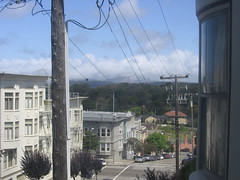
San Francisco

San Francisco

A wonderful city. The air is clean, fresh and bright, and the feeling permeates. Well, it seemed to permeate pretty much everything except my skin. The expression "hitting a funk" bubbled up at the time as the best description of my state. Some combination of the mounting length of time without real personal space, and the contrast between some ugly feelings this brought up and the prettiness around me... all conspired to conjure a less than ideal introduction to the city.

There were good things, of course. I caught Erik Davis doing a reading from his new book on Led Zeppelin in a bookshop on Haight Street, which was a blast. Erik and his wonderful partner Jennifer Dumpert graciously let me crash at their splendid place for a few nights, and the bits of their social whirl that I hooked up with were great. Had some great chats with Erik's fiery, freaky friend Wef, and met a bunch of great DJ/artist friends of Erik's. Sadly, my dancing feet weren't around for the night these guys put on. By then, Erik's sage recommendations from his arcane, extends-to-every-room library had possessed me, a channel to cope with the dark clouds gathering over my head.

James Hillman is an author who's been looming over my horizon for a while now, and his Dream and the Underworld immediately started hitting home, crystallizing some of the vaporous thoughts and feelings I've been having relating to this Dreamflesh journal I'm planning. Even more potent was Michael Ortiz Hill's Dreaming the End of the World: Apocalypse as a Rite of Passage. Published in 1994, the year I started a zine about dreams, the year before I started a journal concerned with apocalyptic themes, it's one of those books that you can't believe you haven't discovered sooner - and yet in a way, you're glad you didn't. In short, it comes at just the right time. Michael's sophisticated yet heartfelt analysis of themes and patterns in people's dreams of nuclear and ecological holocaust resonated deeply with my own perspectives, feelings, and yes, dreams. What's more, the brief biographical details in the introduction - mentioning his period of homelessness and his work with the dying as a registered nurse - underlined his "effort to understand the path of compassion during a tumultuous age" with something more than mere credibility. When he talked of sneaking in to lectures by Norman O. Brown while he was homeless, to listen to this oft-neglected curiosity of classical scholarship colliding with the millennial fervour of the 1960's, the connections deepened (Brown was a key influence on my thinking during the 90's, and I had as yet failed to come across anyone else standing up to claim him as a key source). So I tracked Michael's email down, and got in touch. I'd left the last week of my stay here open for "what may come", and it seemed like Michael fit the bill. Over the next week I gradually planned my trip to visit him in the Santa Monica mountains.

Before leaving San Francisco, my funk came to a head, and Erik's prize cactus bore the brunt. In one of those accidents that immediately feels like psychic steam forcing its way out any which way it can, I knocked over a Tjuringa board that in turn toppled the cactus that was well over a foot high. It's now considerably shorter. Sorry, Erik.

Garberville

So I was in kind of a state on the Amtrak bus north up to Garberville in Humboldt County. Initially, my fragility wasn't helped in the slightest when, just as the landscape started to kick in with beauty and majesty, a few of the other passengers lobbied to get a video showing. The gaudy teen-flick vibe of Orange County's opening half-hour sent me reeling into a profoundly stressed space between America's good (outside drifting by) and bad (inside being loud at me). But, the film turned out to be kind of interesting and pretty funny in a goofy-but-intelligent way. Jack Black has a very-much-in-his-element turn as a drugged-out loser, and there's some great supporting roles filled by Lily Tomlin, John Lithgow, Chevy Chase and Harold Ramis (doing a great scene as a Stanford dean getting spiked).

Northern California

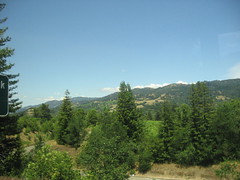
As we hit real redwoods-and-windy-rivers country, I was thrilled and privileged by my first site of the Eel River: an osprey plunging straight into the waters and emerging swiftly with a fish in its claws. I was in love with birds of prey as a kid, and this is one of the archetypal scenes of such a love. My jaw dropped. When the first really fucking big redwood trunks slid by, a tear threatened to drop from my eye. There are no words for such impassive, undeniable presence.

Scott's place

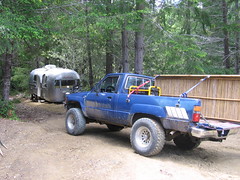
I was in Garberville at the invite of a friend of a friend, Scott, who met Merrick while he was at the protest against the extension of the Manchester Airport runway. Scott lives in an Airstream trailer (while he builds his cabin) on some land way up in the hills near Garberville, and works with the Trees Foundation, a charity helping grassroots groups to preserve the ecological integrity of the Pacific Northwest. The week I arrived he was working with some other people preparing to do a fund-raising Thai noodles stall at a festival that weekend. Unfortunately the festival itself clashed with the dream conference I'd come to attend in Berkeley, but it was gratifying fun to muck in a help paint signs and such like for the stall.

My residence in Garberville

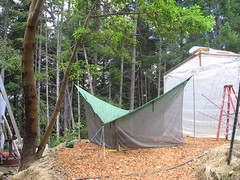
Scott was - like pretty much everyone who's extended their hospitality to me over here - a gracious and generous host, and we put up a groovy tent (actually more of a grandiose mosquito net) for me to get some up-close-with-nature time during my stay. Connecting with Scott that first night was great. Feeling more and more ecological ideas weave themselves forcefully into my thinking for Dreamflesh journal, I found myself hitting the classic writer's guilt about not doing enough practical, hands-on work. If the environment's so screwed, shouldn't I be learning permaculture and agitating instead of waxing philosophical? Naturally I'm never much of an either/or person, but I do manifest an imbalance... But then here was Scott, someone devoting so much energy to pragmatic activism, and yet, at least that night when I arrived, he felt starved of perspectives, ideas, inspiration. So between Scott's responses to my loquacious musings, and my lending a hand to Scott's stall construction efforts, we seemed to find exactly the kind of fruitful meeting and exchange we both needed. Cool.

Redwood tree

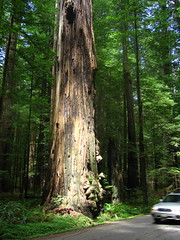
Sadly I was stricken with flu and allergies the next day (and for over a week from there, in total). One of Scott's first, fatal remarks to me were, "Oh, I've got a bit of a cough, but don't worry, it's not catching." But despite the hacking and sniffling, I couldn't not appreciate the humbling redwoods in the Humboldt State Park, on a daytrip with with Scott's girlfriend Joan, and her friend Matt from New York.

The strange little town of Garberville, I soon learned, is renowned for its dope-growing. Oddly, I missed out on sampling some while I was there. But knowing this, the hemp shop and the fantastic organic bagels and smoothie shop fell right into place, as did the wiry Latino guy called J-Bird who approached me about ten minutes after I arrived asking if I wanted to smoke some pot with him. I also remembered a great little film called Homegrown about dope-growing in northern California, and realised where the region depicted there hooked up to the place I was now in.

On my last night there, I checked out the tiny cinema to see Enron: The Smartest Guys in the Room. It's an essential film for our times. Seeing it in California - especially such an environmentally-conscious area of the state - added some force to it, given those infamous recordings of Enron traders as they create California's rolling blackouts for blatant, ugly profit. And yet more Dreamflesh concepts resolved themselves into sharper focus; the Enron saga seems to be as crucial as 9/11 for understanding what's going on in our world now, and it seems to me there is more than a little uncanny cosmic resonance in the fact that CEO Jeff Skilling resigned a week before the World Trade Center was destroyed.

Berkeley and the Dream Conference

The tail-end of my flu kind of smothered my engagement in the Association for the Study of Dreams conference in Berkeley, but it was definitely worth my while. I loved Berkeley itself. Being the old stomping ground of Philip K. Dick and Terence McKenna, among others, it had strong associations for me, and it didn't disappoint. As pretty in its way as the hipper parts of San Francisco, but lower-lying and less assuming, seemingly more at ease with its run-down aspects, it exuded a relaxed kookiness evident in its wildly diverse religious communities. Curiously, the evident Indian and Pakistani community - I grabbed some very passable samosas on University Avenue - made me feel quite at home, having spent most of my adult life surrounded by transplants of these cultures in Leeds and London. Yet more warm hospitality came in the form of Antero and Sylvi Alli, whose place was the picture of esoteric Berkeley homeliness.

The conference opening didn't bode well. A woman had been invited to initiate proceedings with a song. She explained very sincerely that she had done "a lot of research" on the internet about dreams, songs, and the current world situation, but when she started her backing tape and some terribly standard pseudo-soul session music issued forth, I braced myself. She launched into some sub-'Ebony and Ivory' lyrics about dreaming of a better world, and asked us to clap along and sign the word "dream" in the chorus. My ice is often reluctant to break with these things, but break it will, given enough seduction through humour, intelligence, or just plain charisma. Sadly none of these showed themselves, and I half-heartedly suppressed my smile as I wrote, "... this is California. I have arrived."

It was good to see some of the "big names" in consciousness research - Charles Tart and Stan Krippner being the most prominent - but as is usually the case with conferences, it's the impassioned people with less of a standing that make the most impact, that and the social connections. Texan Bitsy Broughton's talk on manifesting connections with dream animals, entwined with working with ancestors and a vision of dream animals' relevance to our ecological crisis, set a chorus of bells ringing for me, as did the brilliant Jeremy Taylor's lucid, gutsy approach to dreamwork and social justice. The panel on dreams and spiritual practice could - given the tone set by the opening song - have been pretty uninspiring, but Anne Hill and Rose May Dance (both from the Bay Area witchcraft group Reclaiming) gave us some righteous, open-minded, grounded perspective from their work with dreams in group rituals and solo retreats, and Jungian psychologist Meridith Sabini managed to bind her own thoughts with Jung's and conjure a palpable sense of spiritual common ground in the room.

I met a couple of great people: Brian Mills MacGregor, a bright-eyed and bushy-tailed artist from Savannah, Georgia, and Clare Johnson, a fellow Limey who researches lucid dreaming and creativity. We drank to our common achievement of having managed to avoid regular working hours for most of our lives.

Dream Telepathy contest hugs

On the Sunday night, there was the Dream Telepathy contest. Someone concentrated on one of three previously unseen images that had been especially posted in, and if people felt their dream that night connected with any of them, they put their dream in an envelope next to that image. The closest match wins. Clare had actually won the year before. Stories abound of people in previous years having gained lucidity in their dream to go searching for the image being transmitted; I hadn't been dreaming much at all on my travels, so I didn't hold out much hope of hitting any connection.

Well, before the contest, of course, we had to establish some form of personal connection with the "sender", so we all lined up to give her a hug, which was great fun, reminding me of those Indian gurus who go around do gigs at arenas where everyone lines up for their hug-dispensed prana. I did a little affirmation to dream before crashing, and dozed off in a red wine haze. I was pretty shocked to wake up the next morning with the vivid memory of becoming lucid in my dream and going, "Oh yeah, there's this contest on. Where's that woman who's sending the image?" I ran around looking for her, finding one woman, deciding it was the wrong one, then moving on a trying to find another, and so on. Well, all this feminine contact seemed to veer off in a direction that derailed my lucid awareness of the situation (dreams aren't much different from waking life in many respects), and before long I was introduced to an especially beautiful young woman naked from the waist down. Things became, how shall I put it... predictably personal. Suffice it to say, I had zero success with the telepathy thing.

Mulholland Drive

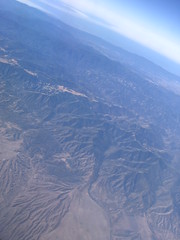
Flying south to LA

By now I had booked myself a flight to Burbank and a hire car for me at the airport. The plan was to visit Michael Ortiz Hill in the Topanga hills west of Los Angeles, then take it easy driving back up to the Bay Area along the Pacific coast.

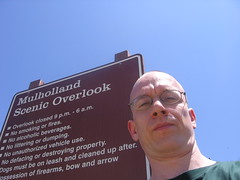
Hitting Burbank was interestingly crazy. I'd driven a bit up in Garberville and was pretty used to driving on the wrong side of the road, but the LA freeways are something else. I decided, given my intense love for David Lynch's Mulholland Drive, and as a huge stretch of that mythic road took me to the region I was heading for, I just had to go that way instead of saving a bit of time of the madcap, choked freeway. So, brushing past the Hollywood Hills, down through Coldwater Canyon, really digesting Lynch's comment about the optimistic quality of the light and quickly absorbing what I could of the intense cultural emanations of this area for me (Red Hot Chili Peppers, Jane's Addiction and Fishbone - all locals - were my three favourite bands as a teen), I joined Mulholland and headed west. Actually I missed the turning first time, giving me a little taste of things to come. You see, Mulholland Drive is impossibly twisty. I knew Lynch built on this quality in his labyrinthine, tricksy narrative structure in the film, but I wasn't quite prepared for the in-the-flesh insight I was about to get into that story. There was one bit where you had to kind of join another road and rejoin Mulholland, but as far as I felt able, I kept heading west.

Mulholland Drive

Then I saw some traffic lights approaching. The junction looked familiar, but I didn't recognise it. Suddenly it hit me. I was at the very junction where I had initially joined the road, only now heading out of it in the other direction. Such a spatial flip really hits you on a gut level. I could comprehend making a wrong turning - but doubling back on yourself, maybe two miles along then two miles back again, and only clocking it right at the end? The moebius strip quality of Mulholland Drive's plot seemed to now be etched into my brainstem. I gasped and reeled (and cursed), and meekly headed for the freeway.

Topanga Canyon

Topanga Canyon

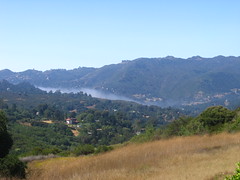
Michael's place is tucked away right at the end of a tiny road in the Santa Monica mountains near Topanga, a fantastic area ripe with the bohemian overflow from Hollywood, where the semi-arid hills ooze displaced Chumash myth and entrenched hippy dreams. Michael has been initiated into a Bantu tradition of healing by his mapatya (spiritual twin), Augustine Kandemwa, and, together with his humbling (for him and for anyone who reads of them) experiences as a registered nurse at UCLA Medical Centre, he comes across as someone engaged with compassion and spirit to the utmost degree. A Liberian guy, whose peacemaking efforts Michael is involved with, dropped by soon after I arrived. Michael told me of this guy's brother, who was tortured to death during the civil war, and how this event forced him to a place where he knew he could take the path of vengeance or peace. It's a realm of moral choice I have zero experience of; but it's so heartening to meet people who have been there and braved such impossible forks in their paths.

I did a brief interview with Michael, then he read my tarot cards and performed a little ritual for me to get healing dreams when I slept up on the hill behind his house that night. Offering tobacco to a Buddha that Michael had once buried under the site of the first nuclear bomb explosion in New Mexico as part of an intensive ritual for peace, I gingerly smoked some too. (I swore to never smoke tobacco under any circumstances again about 6 years ago, but refraining here didn't seem right. Any connection with the indigenous traditions of the Americas pretty much involves this highly sacred plant.) Michael sung his prayers in Bantu and Spanish (he's half Mexican), and deposited me under a tree on the hill.

No dreams as such really came that night, but, as I was braced for something "real-seeming" (my strong dreams sleeping out are usually of things that seem to be there, very real), a certain event became my "dream". I'd asked Michael for a blanket in case the night got chilly, but later he'd decided to bring up a duvet just in case. He said I was snoring when I came. My experience was a half-conscious fright as something brushed against my body and a light flashed above me. I lay motionless, terrified of looking around to see what had touched me. I was actually warm enough at that point, and before I got the courage to investigate, the warmth of the duvet soon had me sweating profusely. Of course I felt pretty silly when I realised a very mundane duvet had been benevolently placed on me. I could pull off some of my shiny sleeping bag and huddle up with the duvet's softness. Michael took this as hugely symbolic, a feeling he saw confirmed in his I Ching reading for me over breakfast. My coin throws brought up the K'un (The Receptive) hexagram, with the middle line of the lower trigram changing it to Shih (The Army). I don't know my I Ching, but Michael was pretty struck by how positive it all looked. The chili and cheese omlette tasted better and better as we discussed the reading.

[Final installment soon...]